People can accept that they were wrong. What they cannot accept is that their entire life was wasted.
- By Rabbi Landau
- Duration: 1 minute
Concepts: Wisdom, Speech, and Community Ego Truth Personal growth
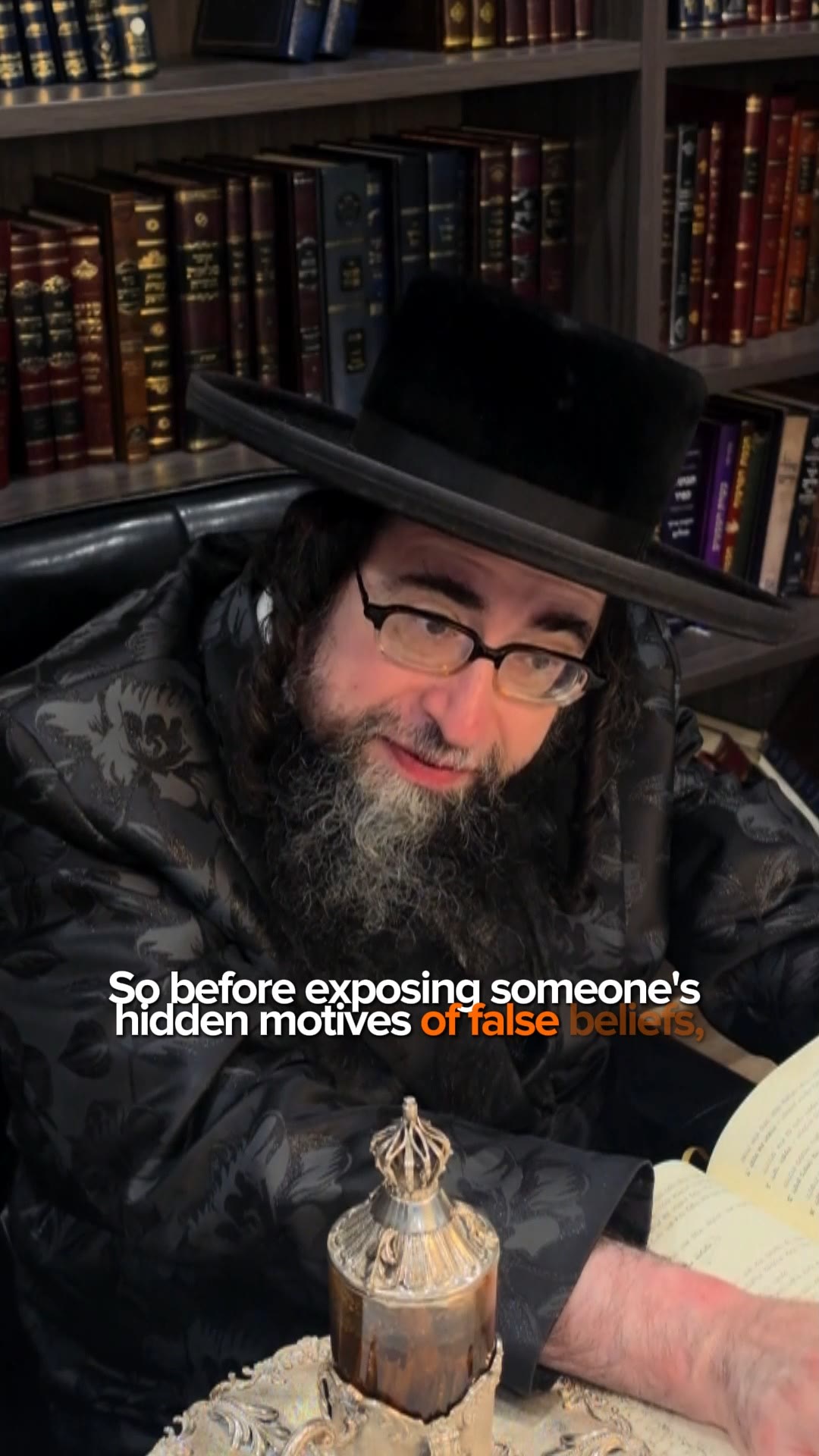
Rabbi Landau teaches People can accept that they were wrong. What they cannot accept is that their entire life was wasted.
Instagram caption
People can accept that they were wrong. What they cannot accept is that their entire life was wasted.
Before you expose someone’s false beliefs, think about what you’re asking them to lose: Years of decisions. A marriage. A career. A lifetime of sacrifices. They aren't fighting the truth; they're afraid of their past.
I once told a 70-year-old man who realized his life was driven by ego: "Look how many people you helped and what you built because of it!"
Hashem uses even our false motives to bring us where we need to be.
וְזָכַרְתָּ אֶת כָּל הַדֶּרֶךְ אֲשֶׁר הוֹלִיכֲךָ ה׳ אֱלֹקֶיךָ.
Just because your motives were wrong doesn't mean your life was wasted.
✨ Support the mission → https://rivnitz.com/donate
Questions this teaching answers
Questions from this teaching
Q: Why is it so difficult for people to admit they were wrong about their beliefs?
Rabbi Landau answers: In my experience, people can accept that they were wrong, but what they cannot easily accept is that their entire life was wasted. When you confront someone with their false beliefs, they fear losing the validity of their past decisions, their marriage, their career, and a lifetime of sacrifices. They are not necessarily fighting the truth; they are afraid of what it means about their history.
Q: What should I consider before exposing someone's hidden motives?
Rabbi Landau answers: Before you expose someone's hidden motives or false beliefs, I ask you to think about what you are asking them to lose. You are potentially shaking years of their decisions, their parenting, their divorce, their career, and their deepest sacrifices. Understanding that their resistance is rooted in fear of an invalidated life allows you to view them with empathy rather than judgment.
Q: What advice do you give someone who feels guilty about living for attention or e
Rabbi Landau answers: A man over seventy years old recently told me with great remorse that his entire life was about seeking attention. I told him to look at how many people he helped and what he built thanks to that very drive. I believe Hashem uses even our flawed, attention-seeking motives to direct us to where we need to be and to accomplish real good.
Q: What does the Torah say about looking back on a flawed past?
Rabbi Landau answers: The Torah teaches us, 'וְזָכַרְתָּ אֶת כָּל הַדֶּרֶךְ אֲשֶׁר הוֹלִיכֲךָ ה׳ אֱלֹקֶיךָ'—you shall remember the entire journey that Hashem your God led you through. I believe this reminds us that Hashem was guiding our path through every stage of life, including the times our reasons were flawed. We must look at the entire journey and recognize that God was directing our steps.
Q: Does having selfish motives mean that the good things I did do not count?
Rabbi Landau answers: Not at all. Just because your motives were wrong does not mean your life was wasted or that your accomplishments disappear. Hashem works through our imperfect human drives to help other people and build meaningful things in this world. Your past contributions still hold real value, even if your underlying intentions were mixed.
Sources and background
The teaching, expanded
When we see someone fiercely defending a flawed path or clinging to a narrative that clearly no longer serves them, our immediate impulse is often to correct them with raw logic. We think they are fighting the truth out of stubbornness or pride. But more often than not, they aren't fighting the truth at all; they are terrified of what accepting the truth will say about their past. People can tolerate discovering that they made a mistake yesterday. What is nearly impossible to bear is the crushing fear that thirty or forty years of sacrifices, choices, career decisions, or family dynamics were an absolute waste.
Psychologists who study adult development observe that as we mature, each of us undergoes an inevitable life review. We look back across the decades to weigh our contributions and assess whether our journey mattered. The terror in that moment is not admitting a miscalculation; it is the threat of existential despair—the paralyzing realization that time has run out to start over. Surrendering a belief that anchored half a lifetime feels dangerously close to psychological annihilation. If we shatter someone's worldview without offering them a way to redeem their history, we are not offering them illumination; we are threatening them with demolition.
Not long ago, a man over seventy sat with me in genuine anguish. Looking back over his long career, he had come to a painful conclusion: "Rabbi, my whole life was driven by a need for attention. Everything I did was about ego." The weight of that regret was suffocating him. But I asked him to look at the reality of what stood in the world because of his effort: the families he had supported, the organizations he had established, the people who were sustained by his work. "Yes," I told him, "your underlying drive may have been a desire for recognition. But look at what Hashem allowed you to build through it. Perhaps the Master of the World used your need for attention to accomplish things a less driven person never would have touched."
Chazal established this foundational truth centuries ago: a person should always engage in Torah and good deeds even *shelo lishmah*—with mixed or self-serving intentions—because through the imperfect motivation, one eventually reaches the pure (*shemitoch shelo lishmah ba lishmah*). The Torah does not expect us to emerge into this world as pristine, unblemished souls whose every motive is crystal clear from youth. We begin with raw, messy, and human drives. Developmental science calls the healthy redirection of these drives sublimation; in the language of Torah, it is the holy work of enlisting the *yetzer hara* into the service of Heaven.
When Yosef revealed his identity to his brothers in Egypt, they were paralyzed with terror, bracing themselves for retribution. But Yosef offered them a profound theological lifeline: "You thought to do me harm, but God intended it for good." If the Almighty can take the genuine wrongdoing of others and weave it into salvation, He can certainly redeem our own confused beginnings. The Talmud goes so far as to teach that when a person returns to Hashem out of love, even deliberate missteps are transformed into merits. Flawed chapters are not excised from our life story; they become the very fuel that deepens our empathy, our humility, and our service.
The Torah instructs us: *"V’zacharta et kol haderech asher holichacha Hashem Elokecha"*—and you shall remember the entire path that Hashem your God led you through. Notice that Moshe Rabbeinu does not say to remember only the highlights, the victories, and the moments of pure spiritual clarity. We are told to remember the entire journey. Every winding detour, every misguided ambition, and every stumble was part of the process through which Hashem brought you to who you are today. Just because your motives were flawed does not mean your life was wasted. When you look back at your own past, or when you guide someone else through theirs, remember that Hashem is not just the judge of our intentions—He is the Master Craftsman who builds eternity out of our imperfect human materials.
Torah sources
- Talmud Bavli, Pesachim 50b (A person should always occupy themselves with Torah and mitzvot even not for their own sake, for from doing them not for their own sake, one comes to do them for their own sake.) — Demonstrates that Judaism recognizes flawed human motives as a necessary, legitimate stepping stone toward higher spiritual truth.
- Devarim 8:2 (And you shall remember the entire way that the Lord your God led you these forty years in the wilderness.) — Underlines that every phase of the journey, including the struggles and detours, is part of Divine providence and carries sacred purpose.
- Talmud Bavli, Yoma 86b (Great is repentance, for when done out of love, intentional sins are transformed for the person into merits.) — Shows that our past errors and misdirected chapters are not irredeemable losses, but can be retroactively transformed into spiritual assets.
- Bereishit 50:20 (Although you intended to do me harm, God intended it for good, to accomplish what is now being done, the saving of many lives.) — Illustrates how Hashem weaves human mistakes and imperfect intentions into the tapestry of ultimate good.
Background reading
Background research gathered for this teaching. These are not Rabbi Landau's words.
In developmental psychology, this fear reflects what Erik Erikson identified as the final psychosocial crisis of late adulthood: **ego integrity versus despair**. During this stage, individuals conduct an inevitable “life review,” reflecting on their choices, sacrifices, and relationships. The terror is rarely about acknowledging an isolated mistake; it is the existential panic of concluding that the sum total of one’s life was misdirected. When someone feels that decades of decisions were founded on an illusion, they face despair—the bitter realization that time has run out to rewrite the story. People will defend a flawed past precisely because surrendering it feels like psychological annihilation.
Research into narrative psychology shows that peace does not come from pretending the past was immaculate, but from reinterpreting its role. Northwestern University psychologist Dan McAdams discovered that the most resilient, productive adults construct **“redemption sequences”** in their life stories. Rather than viewing bad events, errors, or flawed impulses as wasted years, they narratively link those struggles to the positive outcomes that eventually grew out of them. The psychological goal of adulthood is not to maintain the fiction that one’s motives were always pure, but to see that even misguided chapters ultimately served as the catalyst for growth and contribution.
Decades of longitudinal research reinforce that many of history’s greatest achievements began with very human impulses. In the Harvard Study of Adult Development, psychiatrist George Vaillant found that thriving across a lifetime often relies on mature adaptations like **sublimation**—the process of channeling raw, unrefined desires (such as aggression or attention-seeking) into constructive, socially beneficial work. Vaillant observed that healthy people rarely start with immaculate motivations; instead, their underlying drives are redirected over time into creative, professional, and altruistic endeavors. The worth of a life is determined not by the pristine nature of the original drive, but by the good it was harnessed to create.
Book themes
- Wisdom, Speech, and Community — Navigating friendships, honest dialogue, handling conflict, judging favorably, and elevating our interactions with society and fellow human beings.
Emotional pains this teaching answers
The terror that if I honestly admit what drove me, I will have to conclude that my whole life, with all its years, sacrifices and choices, was wasted and cannot be redeemed.
- The fear that my whole life was for nothing
“Just because your motives were wrong doesn't mean your life was wasted.”
- The shame of discovering my good was really about me
“So perhaps Hashem uses even those false motives to bring you where you are today.”
- Holding on because letting go would cost me my sacrifices
“They're not necessarily fighting the truth; they're afraid of what it means about their past.”
- Frustration with someone I love who won't admit they were wrong
“Years of decisions. A marriage. A career. A lifetime of sacrifices.”
Go deeper: five levels
Surface claim
People resist admitting deep errors not because they refuse truth itself, but because doing so risks invalidating decades of life choices, sacrifices, and identity. Even flawed motives can still lead to meaningful contributions and purposeful outcomes.
What may be behind it
The speaker may be cautioning mentors, teachers, and critics to practice gentleness and empathy when challenging others, recognizing that confronting someone with their errors might threaten their entire sense of worth and life narrative.
Underlying need or longing
There appears to be a profound human longing for life to possess retrospective value, coherence, and purpose, ensuring that one's past struggles, time, and emotional investments were not utterly meaningless.
Fear, vulnerability, or tension
There is a palpable fear of existential despair—the terror that late in life, one might discover their foundational motivations were hollow, leaving them with an irredeemable sense of waste and guilt over irreversible decisions.
Deepest human truth
Human beings need redemption more than simple factual correction; individuals can only bear the painful realization of their imperfections when offered a framework that preserves the dignity and ultimate value of their journey.
Download the dossier
This teaching's own words, Torah sources and depth points, in English and Lashon Kodesh. The sefer chapter is not yet linked.
Download the dossier (PDF)Questions this teaching answers
- If I was wrong about something for years, what were all those years for, when I can't go back and live them again?
Being wrong is not the same as having wasted your life, because Hashem was leading you the whole way.
- What do I do when I realize all my giving and building was really so people would notice me? Was any of it ever good?
Even your wish to be noticed was something Hashem used to bring real good into the world.
- Why can't I admit I made a mistake when I gave up so much for this belief, this marriage, this path?
You can admit what was wrong without losing what it cost you, because Hashem was leading that road too.
- Why won't someone I love admit they were wrong when it's so obvious? It feels like they'd rather lose me than admit the truth.?
They aren't defending a lie. They're protecting their life story, and you can help them see that story as meaningful.
Rabbi Landau explains — full transcript
People can accept that they were wrong. What they cannot easily accept is that their entire life was wasted.
So before exposing someone's hidden motives or false beliefs, think about what are you asking them to lose: years of decisions, their marriage, their careers, their divorce, their parenting, lifetime of sacrifices for their beliefs. They're not necessarily fighting the truth; they're afraid of what it means about their past.
You know, a man, over 70 actually, told me last week, "Looking back, my whole life was about seeking attention." And he feels very bad about it. I told him, "And thanks to your attention-seeking nature, look how many people you helped and what you built. So perhaps Hashem uses even those false motives to bring you where you are today."
וזכרת את כל הדרך אשר הוליכך ה' אלוקיך. Remember the entire journey Hashem led you through. Just because your motives were wrong doesn't mean your life was wasted.
Language: en