Stop distrusting your own fluency.
- By Rabbi Landau
- Duration: 49 seconds
Concepts: Mindset and Perception Talent Skills Self worth
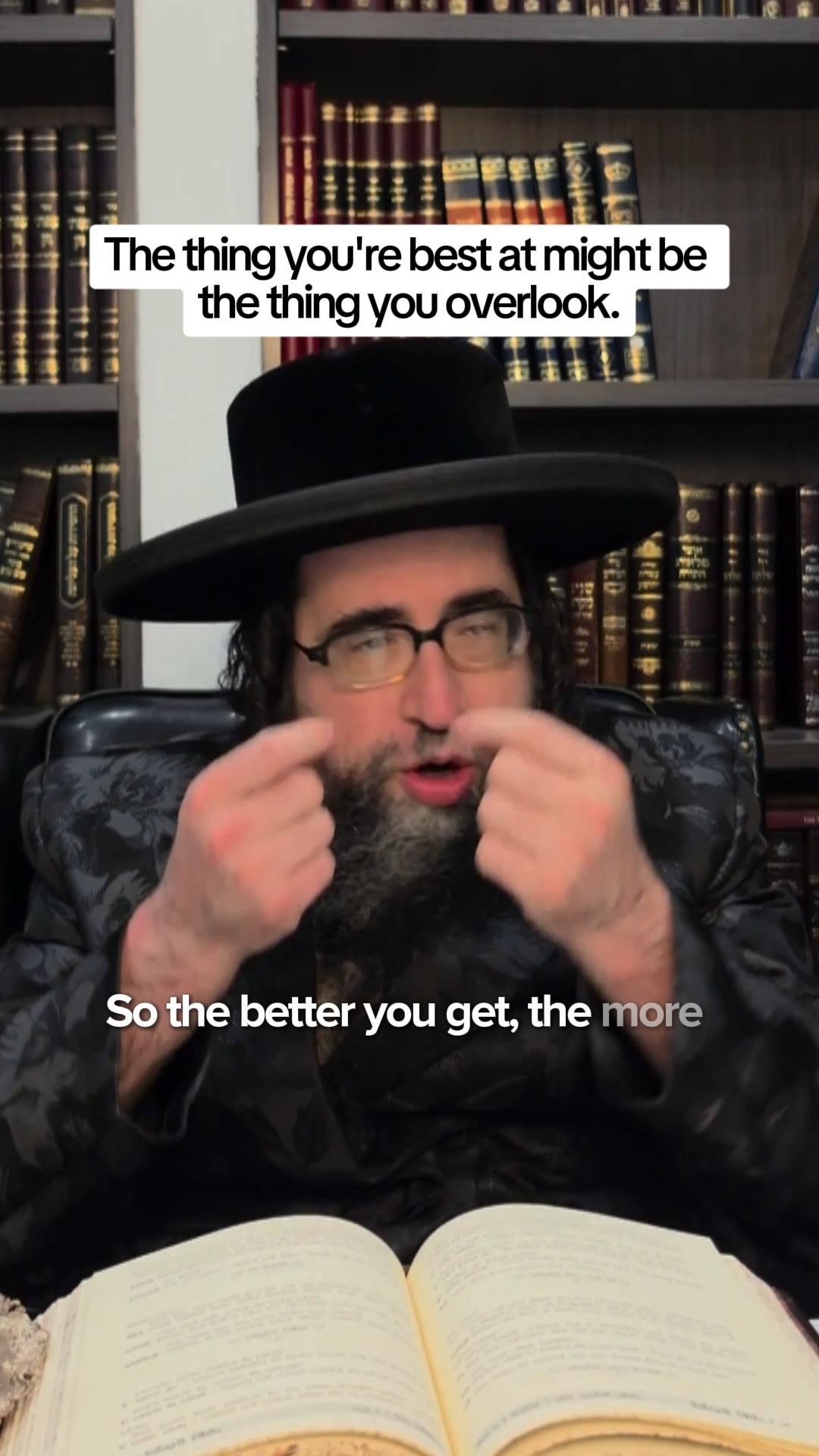
Rabbi Landau teaches Stop distrusting your own fluency.
Instagram caption
Stop distrusting your own fluency.
The moment you truly own a skill, it stops feeling like a skill. It just feels like seeing clearly while everyone else squints. Because it comes easy to you, you assume it's ordinary. You go looking for your talent somewhere else.
That assumption is dangerously wrong.
״חָזִיתָ אִישׁ מָהִיר בִּמְלַאכְתּוֹ לִפְנֵי מְלָכִים יִתְיַצָּב״
King Solomon teaches us: Find the man who is mahir swift, fluent, effortless. That is the one who stands before kings.
Your ease isn't proof that it doesn't count. Your ease is the proof that it's yours.
✨ Support the mission: https://rivnitz.com/donate
Questions this teaching answers
Questions from this teaching
Q: Why do our greatest gifts often feel invisible to us?
Rabbi Landau answers: The moment you truly own a skill, it completely stops feeling like a skill to you. It simply feels like seeing clearly while everyone around you is squinting. Because it feels so natural, you assume it must be ordinary common sense, forgetting to ask yourself who it is actually common to.
Q: Why do we tend to distrust our own fluency?
Rabbi Landau answers: The whole system teaches us to distrust our own fluency by convincing us that effort means extraordinary and easy means ordinary. Because of this false belief, you assume that anything coming naturally cannot possibly be your true gift. You end up looking for your talent everywhere else instead of embracing what you do effortlessly.
Q: What does King Solomon teach about effortless skill?
Rabbi Landau answers: King Solomon taught, 'Chazita ish mahir bimlashto, lifnei melachim yityatzav.' He says that when you find a person who is *mahir*—someone swift, fluent, and effortless in their craft—that is the person who stands before kings. The Torah shows us that true mastery and greatness are marked by effortless fluency, not painful struggle.
Q: Does a skill need to be a struggle to be meaningful?
Rabbi Landau answers: No, that assumption is dangerously wrong. We often convince ourselves that the thing that comes easily cannot be our true purpose. In my teaching, your ease is not proof that it doesn't count; your ease is the absolute proof that it is yours.
Q: How should I view the things that come naturally to me?
Rabbi Landau answers: You should stop dismissing your natural abilities as merely ordinary things anyone can do. What feels effortless to you is a perspective where you see clearly while others squint. That natural swiftness and fluency is King Solomon's definition of true mastery, and it is meant to be honored, not ignored.
Sources and background
The teaching, expanded
The better you get at something, the more invisible your gifts become to your own eyes. True mastery rarely feels like a heroic exertion; it just feels like normal vision. You step into a room, untangle a crisis in sixty seconds, and casually dismiss it as "just common sense." But common sense to whom? To you, the solution was glaringly obvious, so you assume anyone looking at the same situation would have arrived at the exact same conclusion.
From that single false premise, a quiet self-doubt begins to grow. We are conditioned by modern culture—and sometimes even by well-meaning religious messaging—to believe that value must be bought with suffering. In psychology, this bias is called the "effort heuristic." Studies have shown that people instinctively rate the quality of an artwork or a piece of writing significantly higher if they are told the creator struggled over it for days rather than hours. We equate friction with holiness, and struggle with substance. When something flows out of us cleanly and without agony, we suspect it must be cheap.
This self-distrust is the lesser-known flip side of the famous Dunning–Kruger effect. While beginners tend to wildly overestimate their abilities, true experts systematically underestimate theirs. Because a task feels smooth and intuitive to them, they fall prey to what cognitive scientists call "fluency misattribution"—they assume that because it was effortless for them, it must be equally easy for everyone else. Convinced their natural talent isn't special, they go hunting for their calling somewhere far away, exhausting themselves trying to force a fit in areas that require grueling, unnatural friction.
To be clear, we cannot dismiss the foundational Jewish value of *ameilut*—genuine toil. Chazal remind us in Pirkei Avot, *L'fum tza'ara agra*: "According to the pain is the reward." But we must be careful not to confuse productive spiritual exertion with the grinding friction that comes from working against our G-d-given nature. The Torah asks us to labor in perfecting our character and refining our craft; it does not ask us to invent artificial misery to validate our existence. Often, the greatest effort is demanded not in producing an unnatural skill, but in taking the discipline to hone, polish, and channel an innate gift toward holy ends.
This is why King Solomon taught: *חָזִיתָ אִישׁ מָהִיר בִּמְלַאכְתּוֹ לִפְנֵי מְלָכִים יִתְיַצָּב*—"Do you see a person who is *mahir*—swift, fluent, effortless—in his work? He will stand before kings" (Mishlei 22:29). Solomon did not praise the person who drags themselves through every task with visible, tortuous strain. He praised the *mahir*, the one whose mastery has dissolved the friction into swift, lucid clarity. In the Midrash, our sages connect this verse to Betzalel, whose God-given understanding of the Mishkan’s architecture was so intuitive that he knew how to weave the very letters of Creation without faltering.
Every soul is granted a distinct *chelek*, a specific portion of reality that only they are tailored to illuminate. When you discover an area where your mind sees clearly while the room squints, do not turn away to look for something harder. That clarity is not an illusion, and it is certainly not common. Your ease is not the proof that your gift is ordinary; your ease is the signature of your Creator reminding you that it is yours.
Torah sources
- Mishlei (Proverbs) 22:29 (Do you see a man who is swift and skillful in his craft? He shall stand before kings; he shall not stand before obscure men.) — Directly provides the scriptural foundation that fluency and swift mastery—not clumsy friction—are the marks of excellence fit for royal service.
- Pirkei Avot 5:23 (Ben Hei Hei taught: According to the labor and effort is the reward.) — Addresses the classic critique that effort alone determines spiritual worth, clarifying the role of productive exertion versus misdirected struggle.
- Chovot HaLevavot, Sha'ar HaBitachon 3 (Rabbeinu Bahya explains that God instills within each person an innate affinity and inclination toward specific crafts and callings, which serves as a signpost for their designated vocation in the world.) — Demonstrates that natural ease and predisposition are divinely implanted indicators of one's personal mission.
- Midrash Tanchuma, Vayakhel 4 (The sages connect the 'mahir' of Proverbs 22:29 to Betzalel, who intuitively understood how to construct the Mishkan with divine wisdom and understanding without stumbling.) — Illustrates that sacred craftsmanship can be expressed through smooth, intuitive divine fluency rather than painful trial and error.
Questions to discuss
- What is a skill or insight that feels so natural to you that you frequently dismiss it as 'just common sense'?
- How can we distinguish between the sacred labor of self-refinement (*ameilut*) and the counterproductive struggle of working against our innate nature?
- Why do we instinctively value an achievement more when we suffer to attain it, and how does this affect our self-worth?
- In what area of your life could leaning into your natural fluency allow you to serve others with greater joy and impact?
Background reading
Background research gathered for this teaching. These are not Rabbi Landau's words.
In cognitive psychology, this blind spot is the lesser-known flip side of the Dunning–Kruger effect. While David Dunning and Justin Kruger’s landmark 1999 Cornell study is best remembered for showing that novices overestimate their competence, the researchers discovered the reverse among top performers: the highest achievers systematically underestimated their own relative skill. Because the tasks felt intuitive and smooth, they fell into a cognitive bias known as fluency misattribution—automatically assuming that what was effortless for them must be just as easy and obvious for everyone else. When mastery removes the friction, experts project their own ease onto the room and conclude their gift is nothing special.
This self-distrust is compounded by what psychologists call the “effort heuristic.” In a 2004 study published in the *Journal of Experimental Social Psychology*, researchers demonstrated that people routinely use perceived labor as an automatic proxy for quality and value. When participants evaluated identical poems or works of art, they rated the exact same piece as significantly higher in quality and monetary worth whenever they were told the creator spent 18 hours on it rather than four. Human intuition is conditioned to equate friction with significance, causing people to discount their genuine talents simply because they did not have to struggle to produce them.
Book themes
- Mindset and Perception — Examines how internal narratives, cognitive habits, and reframing obstacles alter our experience of reality and unlock personal growth.
Emotional pains this teaching answers
The quiet belief that I have no real gift: that whatever comes naturally to me must be worthless because it came naturally, so I have spent my life looking everywhere except at the thing that was always mine.
- The search for a gift I never found
“So the better you get, the more invisible your gifts become to you.”
- Only what hurts can count
“Effort must mean extraordinary, easy must mean ordinary.”
- Assuming everyone already knows what I know
“You know, sometimes people say it's common sense, but it's common to whom?”
- Years spent chasing someone else's calling
“So you go looking for your talent somewhere else.”
- Not trusting myself enough to stand behind my gift
“Your easy is not the proof that it doesn't count; your easy is the proof that it's yours.”
Go deeper: five levels
Surface claim
The teaching asserts that true mastery feels effortless, causing people to overlook their own innate strengths because they falsely equate worth with struggle and dismiss their natural fluency as merely common sense.
What may be behind it
The speaker may be reacting to systemic conditioning that trains individuals to distrust ease, observing that people might search outside themselves for worth because they have been taught that value only exists where there is visible strain.
Underlying need or longing
There may be a profound longing for self-trust and authentic recognition, where individuals desire permission to value what comes naturally to them and find dignity in their innate capacities without needing to manufacture struggle.
Fear, vulnerability, or tension
There could be an underlying fear of insignificance—the anxiety that if something does not require agonizing effort, it might not count or hold any real merit, creating a persistent tension between internal intuition and external standards of achievement.
Deepest human truth
A fundamental paradox of human nature is that our greatest gifts are often invisible to us precisely because they form the baseline of how we experience the world, making our truest strengths the hardest to claim as extraordinary.
Download the dossier
This teaching's own words, Torah sources and depth points, in English and Lashon Kodesh. The sefer chapter is not yet linked.
Download the dossier (PDF)Questions this teaching answers
- Why does everyone else seem to have their thing while I'm still waiting to find mine? What if I just wasn't given one?
Your gift was never missing; it's hidden because you've gotten so good at it.
- Why do I feel like I don't deserve credit for things that come easily to me? Is it only real if it's hard?
Ease doesn't cheapen your work; it shows the work is truly yours.
- Why do I feel like what I know is too obvious to say out loud? Doesn't everyone already see it?
What looks obvious to you is something others still have to squint to see.
- Why do I keep trying to become something I'm not? What do I do when who I already am doesn't feel like enough?
What you were searching for elsewhere is already flowing from you.
- If something is really my gift, shouldn't I feel it? Why does it feel like nothing to me?
Your gift feels like nothing because it has truly become yours.
Rabbi Landau explains — full transcript
So the better you get, the more invisible your gifts become to you. Because mastery feels like nothing. The moment you truly own a skill, it stops feeling like a skill. It just feels like seeing clearly while everyone else squints. You know, sometimes people say it's common sense, but it's common to whom?
So you go looking for your talent somewhere else. You assume the thing that comes easily cannot be the thing. Effort must mean extraordinary, easy must mean ordinary. The whole system teaches you to distrust your own fluency.
That assumption is wrong, dangerously wrong. חזית איש מהיר במלאכתו, לפני מלכים יתייצב. King Solomon says, find a man who is *mahir*—swift, fluent, effortless—that is the one who is a king. Your easy is not the proof that it doesn't count; your easy is the proof that it's yours.
Language: en