Stop using guilt to avoid doing what's right.
- By Rabbi Landau
- Duration: 49 seconds
Concepts: Emotional Health and Boundaries Art
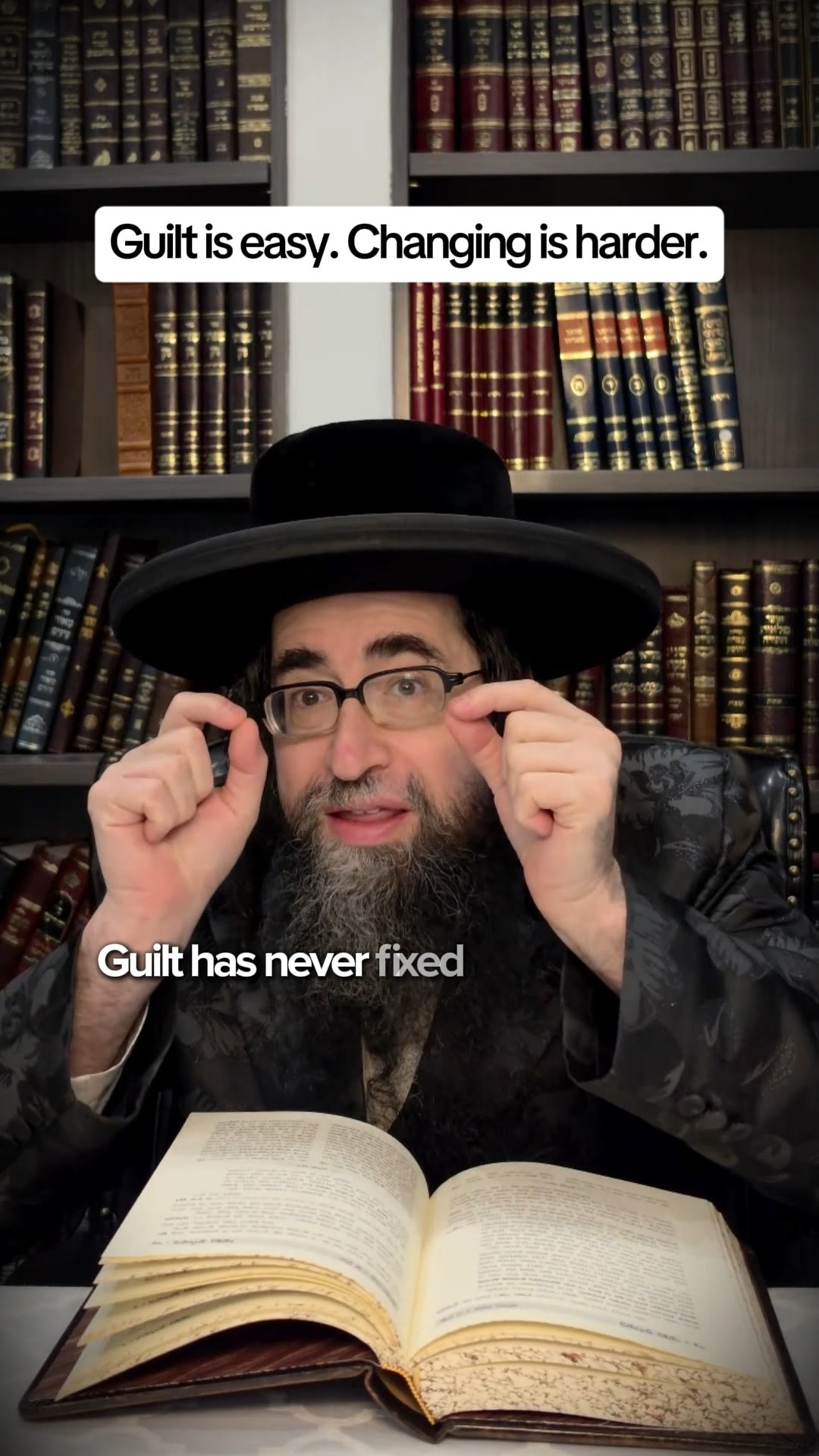
Rabbi Landau teaches Stop using guilt to avoid doing what's right.
Instagram caption
Stop using guilt to avoid doing what's right.
Guilt is just a way to feel like a "good person" while you're still doing nothing. You haven't called your mother in months, you feel terrible every day, and she still hasn't heard from you. All that suffering, and zero phone calls.
Guilt stares at the past. Responsibility acts on the future.
ומודה ועזוב ירוחם
King Solomon tells us: It’s not about the weight you carry; it’s about the change you make. Stop being "stuck" and start being responsible.
If guilt could fix it, it would have been fixed years ago.
✨ Support the light: https://rivnitz.com/donate
Questions from this teaching
Q: Does feeling bad about my mistakes make me a better person?
Rabbi Landau answers: Walking around with the weight of guilt for years does not make you a better person; it only makes you stuck. Guilt is simply a way to suffer a little so you can tell yourself that you care, but it leaves everything exactly as it was. If guilt had the power to fix your life, it would have fixed it years ago.
Q: What is the real difference between guilt and responsibility?
Rabbi Landau answers: Guilt sits there and stares at the past, while responsibility gets up and does something. Guilt keeps you trapped in how terrible you feel, but responsibility directs your energy toward the future. One paralyzes you with regret, while the other demands meaningful action.
Q: Why do people stay trapped in guilt instead of taking action?
Rabbi Landau answers: In my view, guilt is often just an easy way to feel like a good person without having to do anything good. For example, you might avoid calling your mother for months and feel terribly guilty every single day, yet she still hasn't heard from you. All that suffering accomplishes nothing because it substitutes emotional pain for a simple phone call.
Q: What practical steps should I take when I know I did something wrong?
Rabbi Landau answers: Responsibility requires direct, practical repair. If you hurt someone, go apologize to them directly. If you broke something, go fix it. And if you genuinely cannot fix what happened, then resolve to do better with the next person who crosses your path.
Q: How does holding onto guilt harm my relationships?
Rabbi Landau answers: When you allow guilt to keep you stuck in the past, you are never the only one who suffers. That unresolved weight drains your energy, and the people who love you end up paying the price for your paralysis. Breaking free through constructive action is a gift not just to yourself, but to those around you.
Q: What does King Solomon teach us about overcoming guilt?
Rabbi Landau answers: King Solomon teaches in Proverbs, 'Umodeh ve'ozev yerucham'—one who confesses and forsakes their misdeeds will find mercy. The Torah shows us that spiritual growth is not about the heavy emotional burden you carry; it is about the genuine change you make. Moving forward requires letting go of useless regret and actively choosing to do right.
Sources and background
The teaching, expanded
Think about a familiar scenario: you haven’t called your mother in months. Every morning, you wake up with that familiar knot of shame in your chest. You carry that ache through your commute, you sigh over it at lunch, and you go to sleep feeling like a terrible child. Yet when the week ends, her phone has still never rung. All that suffering, all that emotional exhaustion, and she still hasn’t heard your voice.
What is that guilt actually accomplishing? If we are deeply honest with ourselves, guilt functions as a counterfeit emotional currency. It flatters us. It whispers into our ear, “Look how much you’re suffering—an uncaring person wouldn't feel this bad.” Psychologists have observed what they call the “Dobby Effect,” named after the fictional house-elf who beats his head against the wall whenever he errs. When we make a mistake, our instinct is often to retreat into self-inflicted misery, treating our internal pain as if it pays off our moral debt. But while flagellating yourself dulls your conscience, it offers exactly zero comfort or restitution to the person waiting on the other end of the line.
Passive guilt is, ironically, deeply self-absorbed. When you spend months stewing over an unreturned call or an unresolved hurt, who is the story really about? It has stopped being about the person you neglected. The camera has turned entirely inward toward your own discomfort: *Look at my pain. Look at my burden.* In truth, wallowing in guilt is an avoidance strategy. It protects us from the raw, awkward vulnerability of genuine responsibility—picking up the receiver, admitting we fell short, enduring a difficult conversation, and doing the hard work to repair what we broke.
King Solomon cuts straight through this spiritual trap in Proverbs: *Umodeh ve’ozev yerucham*—“Whoever confesses and forsakes his transgressions will find mercy” (Mishlei 28:13). Notice the two verbs Solomon pairs together: acknowledgment and departure. He does not say, “He who beats himself up endlessly will find mercy.” The Torah’s vision of *teshuvah*—repentance—is not an altar for self-loathing; it is an engine for forward motion. True repair requires you to confess your shortcoming and then promptly leave it behind by stepping into right action.
Our sages never viewed perpetual guilt as piety. In Jewish thought, regret is only meaningful if it immediately pivots into *kabbalah al he-atid*—a concrete commitment to the future. Guilt sits paralyzed, staring backward into the past. Responsibility stands up, takes a breath, and acts on the future. If you hurt someone, offer a sincere apology. If you broke something, fix it or pay for it. And if the situation is truly beyond repair, stop punishing yourself and instead channel that painful lesson into treating the next person in your life with greater care.
If beating yourself up could fix what is broken, your life would have been perfected years ago. Put down the useless, heavy luggage of self-punishment. Pick up the phone. Face the awkwardness, take responsibility, and let action take the place of guilt.
Torah sources
- Mishlei (Proverbs) 28:13 (One who conceals his transgressions will not prosper, but he who confesses and forsakes them will obtain mercy.) — Directly supports the principle that redemption requires leaving the wrongdoing behind through positive change rather than clinging to guilt.
- Rambam, Mishneh Torah, Hilchot Teshuvah 2:2 (What constitutes complete repentance? That the sinner abandons his sin, removes it from his thoughts, and resolves in his heart never to repeat it.) — Demonstrates that the Jewish definition of repentance demands concrete mental and practical departure from the wrongdoing, not perpetual self-flagellation.
- Tanya, Chapter 26 (Rabbi Shneur Zalman of Liadi teaches that dejection and paralyzing sadness over one's past shortcomings stem from the Yetzer Hara (the evil inclination), whose true goal is to immobilize a person from serving God with energy and joy.) — Exposes how passive wallowing in guilt acts as a spiritual distraction that prevents a person from doing what is actually right.
Questions to discuss
- In what areas of your life are you currently using internal guilt as a substitute for taking external action?
- Why does self-punishment often feel safer or easier than making a direct apology or initiating a difficult conversation?
- How does the Torah's concept of teshuvah (turning/action) fundamentally differ from modern, chronic feelings of guilt?
- When someone has hurt or neglected you, what actually brings healing: knowing they feel terrible, or seeing them take concrete steps to rebuild trust?
Background reading
Background research gathered for this teaching. These are not Rabbi Landau's words.
In 2009, social psychologists Rob Nelissen and Marcel Zeelenberg published a study in the journal *Emotion* on what they termed the “Dobby Effect”—named after the house-elf in *Harry Potter* who constantly punishes himself for minor infractions. They found that when people experience guilt without taking concrete steps to repair the situation, they instinctively default to self-punishment and self-deprivation. The brain treats internal suffering like counterfeit emotional currency: by making ourselves miserable, we feel as though we are atoning for our lapse. Yet the experiment revealed that while self-flagellation temporarily dulls internal discomfort, it provides zero restitution to the person who was actually neglected or harmed.
Clinical psychologists point out that chronic, passive guilt is ironically self-absorbed. When someone spends months stewing in guilt over an unreturned phone call or an unaddressed hurt, the spotlight remains firmly on their own discomfort—turning the narrative into *“Look how bad I feel, so I must care.”* In practice, this loop functions as an avoidance defense. Stewing in silent misery feels like a moral stance, but it actually insulates a person from the real vulnerability of responsibility: facing the awkwardness of an apology, picking up the phone, or doing the work required to set things right.
Book themes
- Emotional Health and Boundaries — Insights on releasing toxic guilt, overcoming victimhood, setting firm personal boundaries, and transforming emotional wounds into resilience.
Emotional pains this teaching answers
The quiet fear that I am not actually a good person, which I keep at bay by feeling terrible about what I have not done, because feeling terrible is easier than facing the person I hurt and finding out what doing right would cost me.
- The phone call I keep not making
“All that guilt, and not even one phone call.”
- Suffering as proof that I'm still good
“It's a way to feel like a good person without having to do anything good.”
- Frozen by a wrong I can't undo
“You can't fix it, then do better with the next person.”
- My heaviness is weighing on the people I love
“It makes you stuck, and the people who love you end up paying for you, too.”
- Afraid that admitting it isn't enough to be forgiven
“King Solomon says, ומודה ועוזב ירוחם. It's about changing.”
Go deeper: five levels
Surface claim
Guilt does not repair mistakes, help loved ones, or transform someone into a better person; only taking active responsibility, making amends, and changing future behavior produces real repair.
What may be behind it
The speaker may be reacting against the tendency to treat internal suffering as a substitute for moral action, pointing out that passive self-reproach can provide an unearned sense of virtue while leaving relationships damaged and static.
Underlying need or longing
There could be a profound longing for genuine reconciliation, moral agency, and release from stagnation, where energy is directed toward constructive living, authentic healing, and repair rather than enduring unproductive remorse.
Fear, vulnerability, or tension
The teaching highlights a tension between the painful yet safe familiarity of passive guilt and the vulnerability required to face consequences directly. It may point to the fear that past failures are irreversible or that apologizing and attempting change exposes one to the risk of rejection and failure.
Deepest human truth
Suffering internally does not equal caring or making things right; meaningful redemption is not found in retrospective self-flagellation, but in the courage to act, take responsibility, and change course in the present.
Download the dossier
This teaching's own words, Torah sources and depth points, in English and Lashon Kodesh. The sefer chapter is not yet linked.
Download the dossier (PDF)Questions this teaching answers
- Why do I feel guilty every day about not calling my mother but still can't pick up the phone?
The call doesn't have to make up for the months. It only has to happen.
- If I stop feeling guilty about something, does that mean I'm a bad person?
Your goodness is not in how much you suffer but in what you actually do.
- What do I do when I've done something I can't take back? Do I just have to carry it forever?
What you can't fix behind you, you can still make right with the next person.
- How do I stop my guilt from affecting my family? I thought I was only hurting myself.?
Letting go of stuck guilt is not selfish. It's something you owe the people who love you.
- I've admitted what I did over and over in my heart. Why don't I feel forgiven?
Mercy isn't waiting at the end of more confessing. It comes when you change.
Rabbi Landau explains — full transcript
Guilt has never fixed a single thing that you have done, not one.
Think about it. You haven't called your mother in months. You feel guilty about it every single day, and she still didn't hear from you. All that guilt, and not even one phone call.
That's what guilt really is. It's a way to feel like a good person without having to do anything good. Suffer a little, you tell yourself you care, but nothing changes.
Guilt sits there and stares at the past. Responsibility gets up and does something. You hurt someone, go apologize. You broke something, fix it. You can't fix it, then do better with the next person.
Walking around with that weight for years doesn't make you a better person. It makes you stuck, and the people who love you end up paying for you, too.
King Solomon says, ומודה ועוזב ירוחם. It's about changing. If guilt could fix it, it would have been fixed years ago.
Language: en